
The U.S. Food and Drug Administration is cautioning pet owners that eight samples of Raaw Energy dog food have tested positive for one or more types of pathogenic (harmful) bacteria, specifically: Listeria monocytogenes (L. monocytogenes), Salmonella, and Campylobacter jejuni. One sample also contained Escherichia coli (E. coli) O157 bacteria, which may be harmful.
The products are packaged in either 2-pound or 5-pound clear plastic tubes sealed on each end with a metal clip. Products are sold frozen in brown cardboard boxes containing 10 clear plastic tubes.
Because Raaw Energy products aren’t labeled with UPC or lot codes, different batches of product are distinguishable by a date code (date of manufacture) printed on white stickers on both the individual plastic tubes and the brown cardboard box.
Photos are not currently available.
The advisory is for the following products:
2 lb tubes of Chicken Medley with Date Code 7.17.25
5 lb tubes of Chicken Medley with Date Code 11.22.25
5 lb tubes of Chicken Medley with Date Code 12.12.25
5 lb tubes of Salmon with Date Codes 12.5.25 and 12.12.25
5 lb tubes of Beef Chicken Medley with Date Code 12.16.25
5 lb tubes of Beef Turkey Medley with Date Code 12.18.25
5 lb tubes of Beef Chicken Tripe Medley with Date Code 12.23.25
This recall has been added to the Safe Pet Treats app. Available on iTunes.
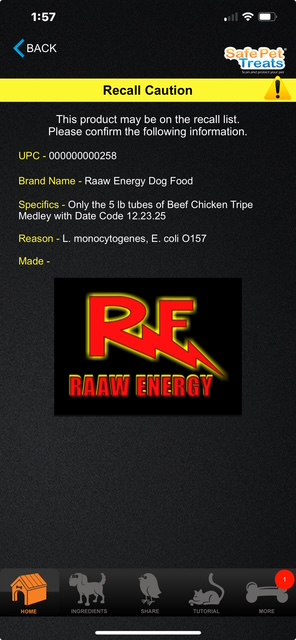
Safe Pet Treats app screenshot
From the FDA website:
Fast Facts
- The U.S. Food and Drug Administration is cautioning pet owners that eight samples of Raaw Energy dog food have tested positive for one or more types of pathogenic (harmful) bacteria, specifically: Listeria monocytogenes (L. monocytogenes), Salmonella, and Campylobacter jejuni. One sample also contained Escherichia coli (E. coli) O157 bacteria, which may be harmful. See the “Product Information” section of this advisory for details on affected date codes and flavors of Raaw Energy dog food.
- Testing occurred as part of follow-up on a consumer complaint submitted to the Connecticut Department of Agriculture (CTDA) about a dog illness. CTDA and the New Jersey Department of Agriculture collected and tested a total of eight unopened product samples, all of which tested positive for pathogenic bacteria.
- Raaw Energy dog food is ordered online and picked up in person by customers. Products are sold frozen and packaged in 2-pound or 5-pound clear plastic tubes sealed on each end with a metal clip. Products are sold in brown cardboard boxes containing 10 plastic tubes.
- The FDA recommended Raaw Energy recall the eight lots due to contamination with pathogenic bacteria. To date, the firm has not initiated an adequate recall of affected products. Consumers who have purchased Raaw Energy dog food should check packaging for the affected date codes prior to feeding to pets.
- If consumers have any pet food on the list below, they are advised to throw it away in a secure container. Do not feed it to pets. Do not donate the food. Clean and disinfect all pet supplies and surfaces that have had contact with the food or pet.
- L. monocytogenes, Salmonella, pathogenic E. coli O157, and Campylobacter can affect both people and animals. People with symptoms of Salmonella, L. monocytogenes, E. coli O157, or Campylobacter infection should consult their health care providers. Consult a veterinarian if your pet has symptoms of Salmonella, L. monocytogenes, E. coli O157, or Campylobacter infection. See symptom information below.
Product Information
Raaw Energy dog food is ordered via the firm’s website and picked up in person by customers. The products are packaged in either 2-pound or 5-pound clear plastic tubes sealed on each end with a metal clip. Products are sold frozen in brown cardboard boxes containing 10 clear plastic tubes. The cardboard boxes have white stick-on labels identifying the product flavor, ingredients, and date code.
Because Raaw Energy products aren’t labeled with lot codes, different batches of product are distinguishable by a date code (date of manufacture) printed on white stickers on both the individual plastic tubes and the brown cardboard box.
Affected Products
| Product | Size | Date Code | Pathogen |
|---|---|---|---|
| Chicken Medley | 2-lb tubes | 7.17.25 | L. monocytogenes Salmonella Campylobacter jejuni |
| Chicken Medley | 5-lb tubes | 11.22.25 | L. monocytogenes |
| Chicken Medley | 5-lb tubes | 12.12.25 | L. monocytogenes Salmonella |
| Salmon | 5-lb tubes | 12.5.25 12.12.25 | L. monocytogenes |
| Beef Chicken Medley | 5-lb tubes | 12.16.25 | L. monocytogenes |
| Beef Turkey Medley | 5-lb tubes | 12.18.25 | L. monocytogenes |
| Beef Chicken Tripe Medley | 5-lb tubes | 12.23.25 | L. monocytogenes E. coli O157 |
What do I need to do?
If you have any of the Raaw Energy dog food products listed above, stop feeding the product to your pets and throw it away in a secure container where other animals, including wildlife, cannot access it. Do not donate the food.
The product date codes are printed on stickers affixed to the cardboard box and the clear plastic tube on both the 2-pound and 5-pound packages of food. If you no longer have the package or cannot read the date code, throw the food away.
Consumers who have had the recalled products in their homes should clean and disinfect all pet supplies, including all storage containers, bowls, utensils, food prep surfaces, pet bedding, litter boxes, toys, floors, and any other surfaces that the food or pet may have had contact with, including your refrigerator or freezer. Clean up the pet’s feces in places where people or other animals may become exposed. Consumers should thoroughly wash their hands after handling the product or cleaning up potentially contaminated items and surfaces.
Why is the FDA concerned about pathogenic bacteria in pet food?
Pet foods contaminated with L. monocytogenes, Salmonella, pathogenic E. coli, or Campylobacter jejuni are of particular public health importance because they can affect both human and animal health. Pets can get sick from the bacteria and may also be carriers of the bacteria and pass it on to their human companions without appearing to be ill. The FDA is aware of cases in which humans and/or animals have gotten sick from exposure to pet foods contaminated with harmful bacteria or to pets that have eaten contaminated pet food (Salmonella – human cases, Salmonella – kittenExternal Link Disclaimer, Salmonella – kitten & dog, E. coli O157:H7 – human). Pets do not need to display symptoms of illness to pass bacteria on to their human companions. Infected pets can shed these bacteria in their feces and saliva, further contaminating the household environment, other animals, and sometimes, people.
To help prevent the spread of bacteria from infected pets to other animals or people, it is important to clean up feces immediately, to wash hands after touching the pet or its environment and avoid contact with the saliva of pets.
The Federal Food, Drug, and Cosmetic Act requires that all animal foods, like human foods, be safe to eat, produced under sanitary conditions, contain no harmful substances, and be truthfully labeled. Neither refrigeration nor freezing eliminates Salmonella, L. monocytogenes, E. coli O157, or Campylobacter jejuni.
What is Listeria monocytogenes (L. monocytogenes) and what are the symptoms of L. monocytogenes infection (listeriosis)?
L. monocytogenes is a bacterium that can cause illness and death in humans and animals, especially those who are pregnant, very young, very old, or have weak immune systems.
According to CDC, listeriosis in humans can cause a variety of symptoms, depending on the person and the part of the body affected. Symptoms can include headache, stiff neck, confusion, loss of balance, and convulsions in addition to fever and muscle aches. Anyone with symptoms of listeriosis should contact a health care provider.
Pregnant women typically experience only fever and other flu-like symptoms, such as fatigue and muscle aches. However, infections during pregnancy can lead to miscarriage, stillbirth, premature delivery, or life-threatening infection of the newborn.
L. monocytogenes infections are uncommon in pets, but they are possible. Symptoms may include mild to severe diarrhea; anorexia; fever; nervous, muscular and respiratory signs; pregnancy loss; depression; shock; and death. Pets do not need to display symptoms to be able to pass L. mono on to their human companions.
What is Salmonella and what are the symptoms of Salmonella infection?
Salmonella is a bacterium that can cause illness and death in humans and animals, especially those who are very young, very old, or have weak immune systems. According to the Centers for Disease Control and Prevention (CDC), people infected with Salmonella can develop diarrhea, fever, and abdominal cramps. Most people recover without treatment, but in some people, the diarrhea may be so severe that they need to be hospitalized. In these patients, the Salmonella infection may spread from the intestines to the blood stream and then to other body sites unless the person is treated promptly. Consult your health care provider if you have symptoms of Salmonella infection.
Pets do not always display symptoms when infected with Salmonella, but signs can include vomiting, diarrhea (which may be bloody), fever, loss of appetite and/or decreased activity level. If your pet has these symptoms, consult a veterinarian promptly.
What is E. coli O157 and what are the symptoms of this type of E. coli infection?
Most but not all types of E. coli O157 bacteria are harmful to people. The initial testing performed did not specify what type of E. coli O157 was found in the affected lot of dog food. Until the FDA confirms the strain of E. coli O157, the agency advises pet owners to be on the lookout for symptoms of the most hazardous strain, E. coli O157:H7. FDA intends to update this advisory when additional information is available. E. coli O157:H7 are a harmful type of E. coli bacteria called Shiga toxin-producing E. coli (STEC). STEC are of particular concern because the bacteria produce Shiga toxins, which can cause damage to the intestinal lining, kidneys, or nervous system. People can become infected with STEC by consuming contaminated food or being in close contact with infected animals, people, or environments. Symptoms may begin anywhere from a few days up to nine days after exposure. Symptoms of STEC infection in people generally include severe stomach cramps, diarrhea, fever, nausea, and/or vomiting. People with possible STEC exposure who develop symptoms of an infection should consult their health care provider.
Some STEC infections can cause severe, bloody diarrhea and lead to life-threatening conditions, such as a type of kidney failure called hemolytic uremic syndrome (HUS), or the development of high blood pressure, chronic kidney disease, and neurologic problems.
Symptoms of HUS can include fever, abdominal pain, pale skin, fatigue and irritability, small and unexplained bruises or bleeding from the nose and mouth, and decreased urination. The condition can lead to serious kidney damage and death. Although people of any age can become infected, children under age 5, older adults, pregnant women, and people with compromised immune systems are more likely than others to develop severe illness and HUS. People who experience symptoms of HUS should seek emergency medical care immediately.
Dogs and cats can become infected with STEC, although the symptoms are generally milder than symptoms in people. Dogs and cats infected with STEC can develop watery diarrhea, bloody diarrhea, urinary tract infections, and vomiting. Symptoms may be more severe in pets with weakened immune systems. The infection is rarely lethal in pets, but deaths have been reported in infected dogs. If your pet has symptoms of a STEC infection, consult a veterinarian promptly.
What is Campylobacter jejuni and what are the symptoms of Campylobacter infection (campylobacteriosis)?
Campylobacter jejuni (C. jejuni) is one of the most common bacterial causes of diarrheal illness.
One way people can get C. jejuni infection is by touching animals (for example, puppies) that carry C. jejuni.
Symptoms of campylobacteriosis infection can include fever, abdominal cramps, and diarrhea (often bloody). In some cases, physicians prescribe antibiotics when diarrhea is severe. The illness can last about a week.
C. jejuni can lead to health complications such as irritable bowel syndrome, temporary paralysis (Guillain-Barré Syndrome), arthritis, urinary tract infections, and meningitis. While most people who contract campylobacteriosis recover completely within 2 to 5 days, some C. jejuni infections can be fatal. Consumers exhibiting any of these signs after having contact with recalled product, a pet that has eaten recalled product, or the bodily fluids or feces of a pet that has eaten recalled product should contact a healthcare provider.
C. jejuni can infect dogs and cats and is more common in young and immunocompromised animals. Dogs and cats infected with C. jejuni can develop symptoms including diarrhea (watery, mucoid or bloody), vomiting, tenesmus (straining), lethargy, and fever. Young, elderly, and immunocompromised animals are more likely to develop severe symptoms, while infected healthy adult animals may not show any symptoms. Campylobacteriosis in pets usually resolves without treatment, but severe infections may require veterinary care.
How can I report a pet illness?
People who think their pets have become ill after consuming contaminated pet food should first contact their veterinarians.
The FDA encourages consumers to report complaints about pet food products electronically through the Safety Reporting Portal. Additionally, consumers can visit the SmartHub – Safety Intake Portal – Report a Product Problem (fda.gov) to obtain electronic assistance with submitting a report.